








Iron Hand, Velvet Glove
String Teacher Betty Haag-Kuhnke
Strad Magazine, December 2001
 As I board the train in Chicago for Arlington Heights, a suberb 40 minutes
north-west of the city, I feel decidedly sceptical. After studying a
large stack of newspaper articles and reviews I know that the pupils
of Betty Haag-Kuhnke, the Magical Strings of Youth, have performed in
Carnegie Hall, the White House, the Kennedy Center and with the Chicago
Symphony. They have toured Europe umpteen times, given three performances
for Pope John Paul II at the Vatican, played in Kazakhstan, Russia,
Taiwan, Singapore, Korea and all over Australia, and broadcast on television
around the world. That, I concede, is impressive. But I think of them
as Suzuki students, and to me that means they're performing monkeys
rather than musical ambassadors.
As I board the train in Chicago for Arlington Heights, a suberb 40 minutes
north-west of the city, I feel decidedly sceptical. After studying a
large stack of newspaper articles and reviews I know that the pupils
of Betty Haag-Kuhnke, the Magical Strings of Youth, have performed in
Carnegie Hall, the White House, the Kennedy Center and with the Chicago
Symphony. They have toured Europe umpteen times, given three performances
for Pope John Paul II at the Vatican, played in Kazakhstan, Russia,
Taiwan, Singapore, Korea and all over Australia, and broadcast on television
around the world. That, I concede, is impressive. But I think of them
as Suzuki students, and to me that means they're performing monkeys
rather than musical ambassadors.
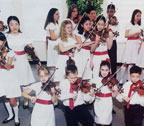
Sound comes before sight when I enter the halls of Roosevelt University's college of the Performing Arts, home of the Betty Haag Academy: it is the last movement of the Mendelssohn Concerto, trills together, dynamics exact, scales in tune. As I peek into a large, mirror-walled dance studio, the dress rehearsal for a performance at the World of Children Awards in Columbus, Ohio is already in progress. Fourteen children are identically dressed: girls in white dresses with red sashes at the waist and black patent leather shoes; boys in white shirts, blue pleated trousers and red ties. What surprises me is the age of the students -- the eldest are 17 but the youngest are just five. The smallest are playing 1/8 size violins with bows that seem the size of toothpicks. 'OK,' I harden myself - 'they're cute but that was only one piece.'
More and more children join them as the programme continues. The Hoe Down by Copland, the Vivaldi A minor Concerto, a number from the Sound of Music, Bartok's Sixth Romanian Folk Dance, Khachaturian's Sabre Dance, La ronde des lutins, Flight of the Bumble Bee, Banjo and Fiddle . . . Piece after piece is perfectly prepared, brilliantly executed and expressive.
 Slowly
I find myself caving in. An hour and a half later, arranged by height
and clad in cowboy hats and bandanas, they play another hoe down, Orange
Blossom Special. What begins as music becomes a spectacular. A row of
children play the left hand of their own violins while bowing the instrument
of their neighbour. The smallest violinists lie on their backs, still
executing perfect detache, with their violins facing the audience, while
the taller ones sink to their knees.
Slowly
I find myself caving in. An hour and a half later, arranged by height
and clad in cowboy hats and bandanas, they play another hoe down, Orange
Blossom Special. What begins as music becomes a spectacular. A row of
children play the left hand of their own violins while bowing the instrument
of their neighbour. The smallest violinists lie on their backs, still
executing perfect detache, with their violins facing the audience, while
the taller ones sink to their knees.
Finally I admit it: I was wrong. These kids are virtuosos and, frankly, I have never heard anything like it. Perhaps more remarkable, their discipline is exemplary yet they are having a great time.
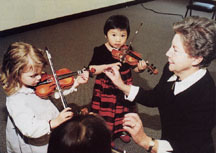
The next surprise is Haag-Kuhnke herself. With results like this she must be a bully, I think. Wrong again. Trim and petite, she wears a conservative but elegant grey suit with black velvet trim and high-heeled shoes. She never raises her voice. Calmly and with consummate control, she advises a child, 'Use no bow in that scale' or says to the group, 'The first note comes from heaven, the last lingers in the hall after you leave, so vibrate.'
 Receiving traditional conservatory training at Indiana University,
Haag-Kuhnke became interested in Shin'ichi Suzuki's teaching after reading
Listen and Play by John Kendall and went to Matsumoto, Japan to work
with Suzuki. 'I was concerned that American society was so different
from the Japanese that his ideas would not work in the West,' she begins.
'Initially I found that because mothers work, I had great difficulty
getting parents involved in music lessons. American parents weren't
used to teaching and felt that music was to be learned from the instructor.
Age three, when children begin lessons, is usually the first time the
child has taken instructions from someone other than its mother. For
success, the mother must assimilate the material I give her, such as
fingerings, bow distribution and bow grip, so she can translate it to
her child. Then at home there must be the correct learning environment.
Ninety percent of parents have no musical background so we are truly
starting from scratch.'
Receiving traditional conservatory training at Indiana University,
Haag-Kuhnke became interested in Shin'ichi Suzuki's teaching after reading
Listen and Play by John Kendall and went to Matsumoto, Japan to work
with Suzuki. 'I was concerned that American society was so different
from the Japanese that his ideas would not work in the West,' she begins.
'Initially I found that because mothers work, I had great difficulty
getting parents involved in music lessons. American parents weren't
used to teaching and felt that music was to be learned from the instructor.
Age three, when children begin lessons, is usually the first time the
child has taken instructions from someone other than its mother. For
success, the mother must assimilate the material I give her, such as
fingerings, bow distribution and bow grip, so she can translate it to
her child. Then at home there must be the correct learning environment.
Ninety percent of parents have no musical background so we are truly
starting from scratch.'
Haag-Kuhnke believes there are many advantages to beginning musical training at such a young age. 'Learning is then at its peak because the brain is growing most quickly,' she explains. 'If you wait until the child is nine, the personality is already set. A teacher can mold and shape a three year old. The muscles themselves are developing memory, and learning a skill such as playing the violin requires constant repetition. As tots they have just come out of another repetition stage - crawling, falling, then finally walking. The beginning is the most vital stage. The child must learn the correct position right from the start. I never allow bad habits to form and just give up. Children will only reach the goals a teacher sets for them, and my standards are very high.'
'One of the big problems in Suzuki schools is that students mostly get poor technical training,' she continues. 'Some teachers think that if students are three years old they don't need good intonation, bow distribution and finger technique; it will somehow come later. You will probably offend some Suzuki teachers by saying this, but I am convinced that to be a great teacher one has to be a fine player and an excellent musician. For me this is not fun and games. Music is a discipline. Without discipline students will never have the freedom to be creative. Musical ideas can come after intonation, tone and proper technique in the left and right hands. On the other hand, I never assume that a child cannot understand phrasing or dynamics, but technique must come before interpretation.'
Years of experience have shown Haag-Kuhnke that children go through three stages of learning. The first she calls 'crawling', when the pupil is trying to negotiate new technical skills with the bow and left-hand position. This is evident in the 'pre-Twinkle' tune Seesaw, a little melody containing string crossings and one finger. The next stage, 'Threshold,' is identified when the parent claims that their child can play it at home but not at the lesson. This inconsistency arises because there is not yet enough repetition and reinforcement. 'Over-learning' is the final stage - the most difficult because so much time and repetition is required. Most students prefer to leave the piece and go ahead with something new.
Haag-Kuhnke is convinced that all children are capable of learning the violin if they have the proper environment and nourishment at home. 'I have seen all types of parents,' she confides. 'For example, the mother is re-living her own frustrations - I will love you if you play the violin. This is conditional love and doomed to failure because the child will always look outside themself for approval. Practice, effort and involvement are important - not winning a competition. At the end of the lesson I give treats for effort, not for results. I want learning music to be a positive experience. Their hearts and souls should be filled with love for music forever.'
Classes begin in groups of four, Haag-Kuhnke having found that interaction between the children allows them to learn faster. Later, though, she regroups according to ability level, so the faster learner will not be held back and the slower one not intimidated. 'As the chilren progress and learn the repertoire I allow the little ones to join the older ones they wish to emulate.' (I witness the intense interest among the youngsters on the sidelines during the rehearsal - they are itching to play and mime the notes on their diminuitive violins with their left hands.) 'In class they learn from each other, there is the social aspect. They love to play together and imitate.'
The motivation and drive to excel also goes through three stages. First the children seek the approval of their parents, wishing to please only them. This then changes to seeking the teacher's approval. Haag-Kuhnke believes she has succeeded only when the student looks to self-realisation and wishes to please his or her own soul, and is able to give this love to the audience. In promoting this goal, she shows the pupils great respect. 'They trust me when I say something good. I am honest and don't falsely praise the children. In fact I have been called "the demure woman with an iron hand in a velvet glove." If a child doesn't want to learn, they can go to someone else. On the other hand, no matter how bad the lesson is, I find something good to say. If you always complain you close the doors to their learning. The students know what I expect. I am very serious and don't clown around.'
Maureen Gottesman, whose daughter Jessica has been in the programme for eight years, since she was almost four, describes Haag-Kuhnke in similar terms. 'Mrs. Haag does not compromise her standards. At every level she expects excellence and never lets the details slide. She seems to know what every student needs and reacts with either tenderness or a firm hand. The children respond in both their music and their school work. We still laugh about a comment Jessica made to her father shortly after she began lessons. He had just asked her to go and do something for him but she refused. When questioned, she responded: "Well, you are not God and you are not Mrs. Haag"!'
Suzuki's theory was that since children learn to talk before they read, they should also learn the rudiments of violin playing through listening and imitation without the added distraction of reading music. This view has been widely criticised by traditional teachers. Haag-Kuhnke begins her students reading while they are still learning repertoire from the first book. They can be as young as three when they first play note-reading games. She confesses: "their ears are so good that their eyes get lazy. Listening to tapes trains them for good intonation, which I think is 90 percent of playing the violin. What most people don't understand is that when the child begins to read notes, the lessons become like the traditional approach. I teach scales and etudes and for that they have to read music.' She recounts the first time her students played with the Chicago Symphony Orchestra. After the rehearsal, one musician turned to a colleague and commented that one day these kids would be taking over their jobs. The other replied not to worry because, as Suzuki students, they couldn't read music. 'I was so mad!' she fumes. 'My consolation came at the end of the week when I received a call from Henry Mazer, the orchestra's associate conductor. He said I should call him when my students learnt to read and he would start an orchestra. My reply was, "come this Saturday". He came and stayed 15 years. When we did Bartok's Divertimento the youngest child was seven.'
Commenting on the label 'Suzuki teacher', Haag-Kuhnke insists there is a misconception. 'Teachers think that they have to rigidly follow the ten volumes of Suzuki's music. Dr. Suzuki told me that the teacher must give a child what they need when they need it. I give my pupils lots of other materials to build a foundation. I do my own thing and don't let the criticism deter me. I am not Suzuki. This is a philosophy and not an idea without a methodology.'
The Betty Haag Academy now has 450 students and 15 teachers including ones for piano and flute. Haag-Kuhnke's students have continued their training at institutions such as Rice and Indiana universities, the Juilliard School and the Curtis Institute and have found jobs in major symphonies and ensembles.
Most of her teachers are former students who have completed their college training and returned. Haag-Kuhnke herself teaches about 100 children a week and conducts weekend group lessons and a repertoire class consisting of 100-200 young violinists. Recently she has merged with the Pre-College Division of Roosevelt University, relieving her from the pressures of running her own business.
Haag-Kuhnke's work finds support in the generous patronage of Mary Galvin, co-founder of the Stradivari Society, who has loaned instruments to the students from her collection and who obtained the sponsorship of the Motorola Corporation for several Magical Strings tours. The Stradivari Society, a foundation that loans exotically priced rare violins to young virtuosos, often sends its recipients to the academy to give masterclasses. The star-studded list of visiting teachers includes Vadim Repin, Aaron Rosand, Sergiu Luca and Vadim Gluzman.
As the interview concludes, the last note of the children's music still lingering in my ears, I ask an improptu question: 'How do we sign up?' Bashfully, Haag-Kuhnke responds: 'It's a long waiting list. Pregnant mothers sign on before their child's birth.' I believe it.
--Laurenel Owen, The Strad Magazine, December 2001